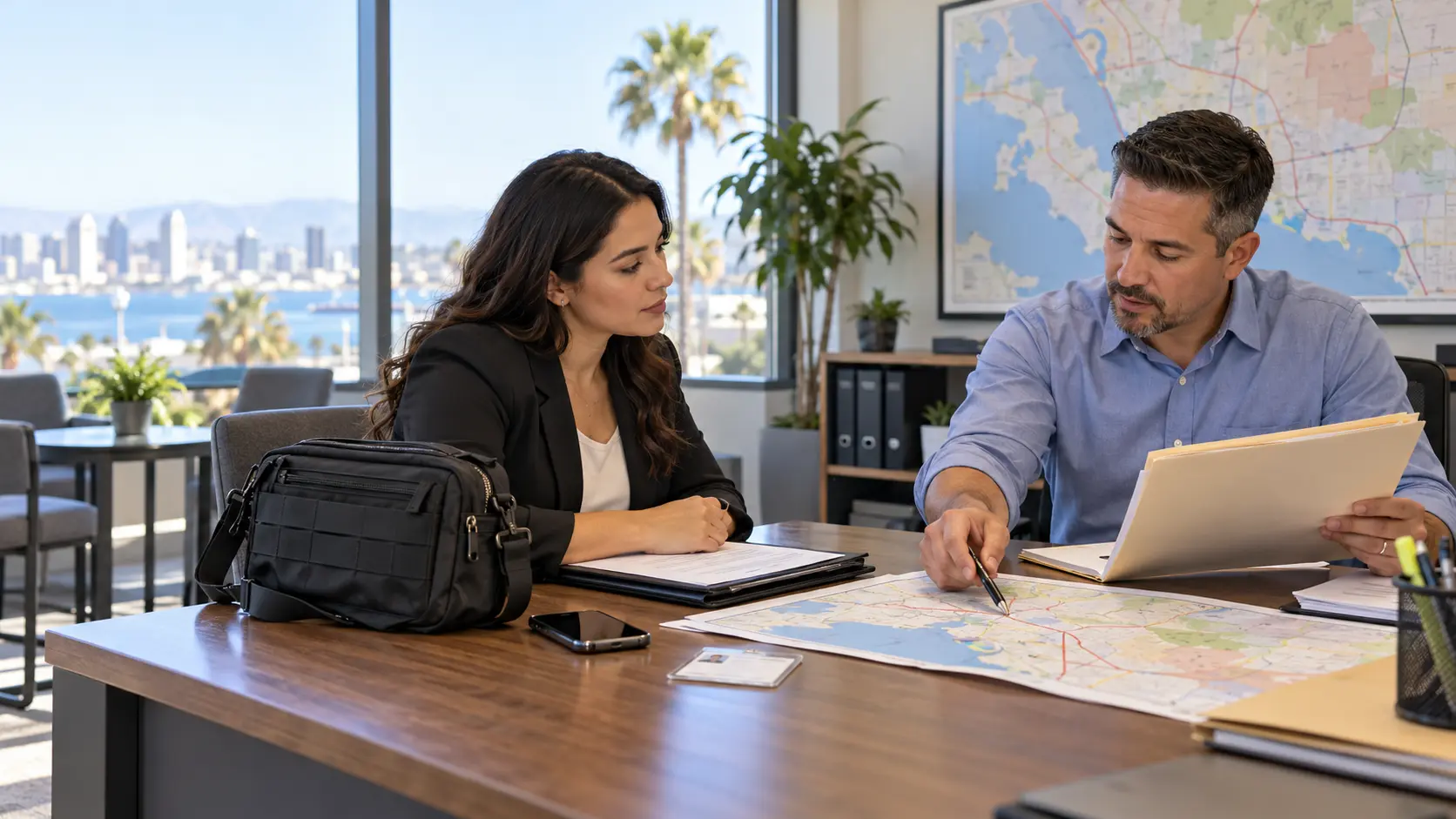
Can a Process Server Serve You in Public in California?
Yes. A process server can generally serve someone in a public place in California if the server is lawfully present, correctly identifies the recipient, and uses a method permitted for the particular documents. Personal service is not limited to a person’s home or workplace. It may occur on a public sidewalk, in a parking lot, outside a restaurant, at a public event, near a courthouse, or in another location where the recipient can be lawfully approached.
The location alone does not make service valid or invalid. The important questions are whether the correct person was served, whether the server delivered the correct documents, whether the interaction satisfied the applicable service rule, and whether the server accurately recorded what happened. A public encounter does not allow trespassing, harassment, physical restraint, unsafe conduct, or disruption of a restricted facility.
This distinction matters for clients who know where a recipient will be but do not have a reliable home address. It also matters when a recipient has not answered the door, works at a secured location, or follows a predictable routine outside the home.
Legal disclaimer: This article provides general information about California service of process and is not legal advice. The correct method depends on the documents, case type, court order, deadline, and facts of the assignment. Laws and court procedures can change. This article was reviewed on September 25, 2026.
The Short Answer
California Code of Civil Procedure section 415.10 states that a summons may be served by personal delivery of a copy of the summons and complaint to the person being served. The statute describes delivery to the person. It does not say that delivery must occur at a residence, office, or other specific address.
As a practical inference from that language, a process server may usually complete personal service anywhere the server can lawfully find and approach the correct recipient. The location can affect safety, access, identification, and how the encounter should be handled, but it does not automatically defeat personal service.
| Situation | Can Service Potentially Be Completed? | Main Concern |
|---|---|---|
| Recipient is walking on a public sidewalk | Yes | Correct identification and clear delivery |
| Recipient is in a restaurant open to customers | Often, if the server may lawfully enter or approaches outside | Business rules, discretion, and avoiding disruption |
| Recipient is beside a vehicle in a parking lot | Yes | Safety, identity, and not blocking the vehicle |
| Recipient is inside a secured courthouse area | Possibly | Security screening, local rules, and restricted zones |
| Papers are left on an unattended car | Usually not personal service | No delivery to an identified recipient |
| Papers are given to a stranger standing nearby | Usually not service on the intended recipient | The stranger is not automatically authorized to accept |
| Server enters a restricted private area without permission | Problematic | Lawful access and property restrictions |
Some documents have special service requirements. A subpoena, restraining order, small claims claim, family law document, eviction paper, or post-judgment document may not follow the same procedure as a civil summons and complaint. The client and server should review the actual documents and instructions before relying on a general rule.
Why the Location Usually Does Not Control Validity
Personal service focuses on delivery to the named person. A residential address is often supplied because it is a practical place to find the recipient, not because California law makes the home the only valid location. The same principle applies to a workplace. It is a lead, not necessarily a legal boundary around where service may occur.
A person who leaves home does not become temporarily immune from service. If the server lawfully encounters that person at a grocery store, coffee shop, park, transit station, or other public location, the server may be able to complete delivery there.
That does not mean every public encounter is automatically valid. A server must still be an adult who is not a party to the case when that rule applies, possess the correct papers, confirm the correct recipient, communicate the nature of the delivery when necessary, and complete an accurate Proof of Service. Special statutes or court orders may add requirements.
The public location may actually reduce uncertainty in some assignments. For example, a client may provide a recent photograph and information that the recipient attends a weekly public event. A discreet approach after the event can be more reliable than repeated knocks at an address where occupancy is unclear.
At the same time, a public sighting should not encourage a rushed or aggressive encounter. The server should assess pedestrian traffic, vehicles, security personnel, children, companions, and available space before approaching. Completing service correctly is more important than creating a confrontation.
Public Places and Publicly Accessible Private Property
People often use the term public place broadly, but there is an important distinction between government-owned public space and private property that invites members of the public inside.
Public Property
Sidewalks, public parks, government plazas, and some transit areas may be public property. Even there, access can be limited by operating hours, permit rules, security zones, court orders, or temporary closures. A server must comply with lawful restrictions and cannot enter an employee-only or secured area merely because the larger facility is public.
Businesses Open to the Public
A restaurant, shopping center, hotel lobby, grocery store, or entertainment venue may welcome customers while remaining privately owned. Management can impose reasonable conduct rules and may ask a visitor to leave. A process server does not acquire unlimited access simply because the doors are open to customers.
If management directs the server to leave, the server should not create a trespass dispute. Depending on the circumstances, the server may wait in a lawful exterior area, arrange another attempt, or approach the recipient as the person exits. The server should accurately document any access restriction.
Restricted Private Areas
Employee-only rooms, private offices, kitchens, gated residential courtyards, hotel guest floors, backstage areas, medical treatment spaces, and ticketed areas may be restricted. The server should not follow a recipient into a prohibited area or misrepresent the purpose of the visit to defeat security controls.
For a deeper explanation of access limits, review our guide on whether a process server can enter private property in California.
Common Public Service Locations
The best location is not always the most dramatic location. It is usually the place where the recipient can be identified reliably, approached lawfully, and served without unnecessary risk or embarrassment.
Sidewalks and Public Parks
A recipient walking on a sidewalk or standing in a public park may be personally served. The server should choose a safe place to approach, avoid blocking the person’s path, and clearly identify the purpose of the contact. If the recipient is running, cycling, supervising children, or entering traffic, the server should wait for a safer moment.
Restaurants and Coffee Shops
Service at a restaurant or coffee shop may be possible, but discretion matters. Approaching a crowded table and loudly describing a lawsuit can create unnecessary conflict. A better approach may be to confirm the recipient visually, wait until the person steps away from the table, or make contact near the exit.
The process server should not claim to be a friend, police officer, delivery driver, or government official to obtain access. If staff will not permit the server to approach, an exterior attempt may be more appropriate.
Stores and Shopping Centers
A retail store or shopping center can provide a lawful opportunity when the recipient is clearly identified. The server should avoid interfering with employees, customers, checkout lines, or store operations. A store manager may ask the server to leave, especially if the interaction becomes disruptive.
Public Events
Community events, trade shows, sporting events, and other gatherings can be useful when a recipient’s attendance is known. Ticketing and access rules still apply. The server should not bypass credential checks or enter restricted areas. A brief approach before or after the event often provides greater privacy and a clearer record than delivery in the middle of a crowd.
Courthouses and Government Buildings
A courthouse may seem like an obvious service location because the recipient is expected to appear there. However, courthouses have screening procedures, courtroom decorum requirements, restricted offices, and local security instructions. Some judicial officers, jurors, witnesses, attorneys, or parties may also be affected by special rules or privileges that require legal review.
A server should never interrupt a hearing, pass papers over courtroom barriers, argue with deputies, or ignore a judge’s instructions. If courthouse service is appropriate, a hallway, public plaza, or exit may be more practical than the courtroom itself.
Airports and Transit Stations
Airports and transit stations contain a mixture of public and restricted areas. A process server may be able to approach someone in an accessible terminal, pickup area, station platform, or parking area, subject to security and fare requirements. The server cannot enter a secured airside area without authorization or obstruct a boarding passenger, vehicle lane, or transportation operation.
Hotels
A hotel lobby may be accessible to visitors, but guest rooms and many guest floors are private. Hotel staff may decline to disclose a room number or connect the server with a guest. If the recipient appears in a lawful common area, personal service may be possible. Leaving papers with front desk staff does not automatically serve the guest.
Hospitals and Medical Facilities
Medical settings require special care. Patient privacy, health conditions, infection controls, visitor rules, and restricted treatment areas can limit access. A server should not enter a treatment space without permission or create distress for a patient. When appropriate, the server may coordinate with facility staff or wait until the recipient enters a public lobby or exterior area.
Schools and Campuses
Schools may restrict visitor access to protect students and staff. A process server should follow check-in procedures and should never attempt to enter a locked campus or classroom without authorization. If the recipient is an adult employee, an exterior or administrative-office approach may be possible. Service involving a minor or school records requires separate legal review.
What the Process Server Must Establish
Successful public place service requires more than seeing someone who resembles the recipient. Before reporting personal service, the server should be able to explain why the correct person was identified and how the documents were delivered.
1. The Correct Recipient
The person served must match the named recipient. A name alone may be insufficient when it is common, the client has limited information, or multiple people at the location resemble the description. The server should use a reasonable combination of photographs, physical descriptions, direct confirmation, known vehicles, scheduled appearances, or information from reliable sources.
2. The Correct Documents
The packet should be complete before dispatch. Missing attachments, an omitted summons, an unsigned order, or the wrong version of a document can create a problem that a successful field encounter cannot fix. The client should provide the case number, party names, service deadline, and any special instructions.
3. A Permitted Method
Personal delivery may be permitted for many documents, but not every document follows the same rule. The process server should not assume that a method used for a civil summons also satisfies a subpoena, restraining order, notice, or out-of-state assignment.
4. Lawful Presence
The server should be in a place where the server is allowed to be. A lawful public encounter does not authorize entry into a locked room, fenced yard, backstage area, employee-only space, or secured terminal. If access changes during the interaction, the server should comply with lawful instructions from property personnel or law enforcement.
5. Clear Delivery
The recipient should understand that legal documents are being delivered. The server does not need to debate the case, explain legal rights, or obtain agreement with the lawsuit. The goal is a clear, professional delivery that can be described accurately afterward.
How Identity Is Confirmed in a Public Place
Identity is often the central challenge in public service. At a residence, address information provides context. In a public place, the server needs a stronger connection between the person observed and the person named in the documents.
Useful identification information may include:
- A recent, clear photograph
- Approximate age, height, build, hair, and distinctive features
- A confirmed appointment, hearing, event, or work schedule
- A known vehicle and license plate supplied through lawful sources
- The recipient responding to a name
- Direct verbal confirmation
- Recognition by a person with reliable knowledge
- Consistent information from prior attempts
A process server should not rely on a weak guess. Clothing can change, photographs can be outdated, and relatives can resemble one another. If identity remains uncertain, it may be better to document the observation and make another attempt than to serve the wrong person.
The recipient is not normally required to show identification to a private process server. A refusal to provide a driver’s license does not prove or disprove identity. The server must rely on lawful observations and information available in the assignment.
What Happens If the Person Refuses the Papers?
A recipient generally cannot defeat personal service simply by refusing to hold the papers after identity has been established and the nature of the delivery has been communicated. California cases recognize that a person cannot avoid service through physical resistance or by refusing to accept documents that are being offered.
In Trujillo v. Trujillo, a California appellate court upheld service where the recipient was identified in a vehicle, refused to open the window, and the server placed the papers under the windshield wiper after explaining the delivery. The decision does not mean that papers may routinely be left on any vehicle. The recipient was present, identified, and aware of the attempted delivery.
In a public setting, a careful refusal service may involve the server stating the recipient’s name, announcing that legal documents are being served, offering the packet, and placing the papers near the recipient when the person refuses to take them. The exact facts matter.
The server should document:
- How the recipient was identified
- What the server said
- What the recipient said or did
- Whether the recipient saw the papers
- Where the packet was placed
- Whether the recipient remained present
- The date, time, and precise location
- Any witnesses or relevant safety conditions
A server should not throw the packet at the recipient, force papers into clothing or a bag, touch the person, or create a dangerous confrontation. If the recipient runs into traffic, drives away, or enters a restricted area, safety comes first.
Service in a Parking Lot or Near a Vehicle
Parking lots are common service locations because they can provide a clear view of the recipient and a lawful approach outside a secured residence or workplace. They also create safety risks involving moving vehicles, limited visibility, and defensive reactions.
A process server should approach from a visible direction, maintain distance from the vehicle’s path, and avoid standing behind or directly in front of a car. The server should not reach into the vehicle, open a door, block the car, or use another vehicle to prevent departure.
If the recipient is inside the vehicle and keeps the doors locked, service may still be possible when identity is established, the recipient understands that legal papers are being delivered, and the papers are placed in a location closely connected to the recipient under circumstances comparable to recognized refusal cases. Because these situations are fact-specific, detailed notes are essential.
By contrast, placing a packet under the windshield wiper of an unattended car is generally not personal delivery to the owner. The vehicle might be used by another person, and there is no confirmed interaction showing that the recipient received notice of the delivery.
Safety, Privacy, and Discretion
Public service should be handled professionally and with as little disruption as possible. Court papers are not a license to embarrass someone. The process server’s role is to deliver documents and create a reliable record, not to punish the recipient or attract an audience.
Keep the Explanation Brief
The server usually needs to identify the recipient and state that legal documents are being served. There is rarely a reason to announce allegations, financial details, family disputes, or other sensitive facts within hearing of coworkers, customers, relatives, or strangers.
Do Not Impersonate an Official
A private process server should not imply that the server is a police officer, sheriff’s deputy, court employee, or government investigator. Clothing, badges, vehicle markings, and verbal statements should not create a false impression of public authority.
Do Not Physically Restrain the Recipient
The server should not block a doorway, grab the recipient, prevent a vehicle from moving, or pursue the person into an unsafe location. A recipient’s attempt to leave can be documented. It does not justify force.
Respect Business and Facility Operations
A restaurant, hospital, hotel, school, courthouse, or event venue may have legitimate security and operational rules. If a discreet delivery cannot be completed without disrupting the location, the server should consider an exterior approach or another attempt.
Choose Timing Carefully
California does not impose one universal daytime-only rule for every service assignment, but timing affects safety and reasonableness. For additional planning considerations, see our article about whether a process server can serve papers at night in California.
Public Service Versus Substituted Service
Personal service on the recipient in a public place should not be confused with substituted service on another person. If the intended recipient is standing outside a coffee shop and receives the papers directly, the public setting does not change the delivery into substituted service.
If the intended recipient is not present, handing the packet to a friend, companion, restaurant employee, security guard, event organizer, or stranger does not automatically complete service. Substituted service is available only when the applicable law authorizes it and its location, recipient, diligence, notice, and mailing requirements are satisfied.
For example, California substituted service of certain civil summonses may permit delivery at a usual place of business to a person apparently in charge after reasonable diligence, followed by mailing. That rule does not generally turn every public location the recipient visits into a qualifying place of business.
Similarly, a security guard at a shopping center is not automatically authorized to accept papers for a customer who has left. A hotel front desk clerk is not automatically a substitute recipient for a guest. The server must apply the rule for the documents rather than improvise a method based on convenience.
What If the Recipient Walks Away?
A recipient may leave as soon as the server approaches, refuse to answer questions, or move toward a private or restricted area. Whether service was completed depends on what occurred before the person left.
If the server had not yet established identity or communicated the purpose of the contact, a sighting alone is not completed service. The server should record the observation and report why delivery did not occur.
If identity was established, the recipient understood that legal papers were being delivered, and the server placed the documents in the recipient’s immediate presence, the encounter may support completed service even if the recipient refused to pick up the packet. The server should record the exact sequence rather than reducing the event to a vague statement such as “subject refused.”
When a recipient repeatedly changes direction, enters secured property, or uses companions to interfere, the assignment may require a revised strategy. Our guide to what happens when someone avoids a process server in California explains how prior attempts, alternate locations, and lawful difficult-service planning can affect the next step.
How Public Service Differs From Workplace Service
A workplace attempt involves business access, employer policies, reception staff, security, and the possibility of substituted service at a usual place of business when legally permitted. A public encounter may occur away from the recipient’s employer and may avoid some access barriers.
For example, a server who cannot enter a secured office may lawfully observe the recipient leaving the building and complete personal service on a public sidewalk. That is personal delivery in public, not substituted service through the employer.
Discretion remains important. The server should avoid discussing the case with coworkers or creating unnecessary workplace disruption. For detailed workplace procedures, review whether someone can be served at work in California.
Documentation and Proof of Service
After successful service, the server prepares the appropriate Proof of Service or declaration. The correct form depends on the case and documents. California Judicial Council form POS-010 is commonly used for a civil summons, while POS-040 may apply to certain civil documents other than a summons. Other case types use different forms.
The Proof of Service should accurately state the date, time, location, recipient, documents, and method of service. If a refusal occurred, additional notes or a declaration may be needed to explain how identity was established and how the packet was placed.
Useful public-service field notes include:
- The complete address or a precise description of the location
- The date and exact time
- Whether the area was public, customer-accessible, or restricted
- The recipient’s appearance and clothing
- The identification basis
- The words exchanged
- The delivery method
- The recipient’s reaction
- Where the documents were left after any refusal
- Relevant security, staff, or witness interactions
- Any safety issue that ended or changed the attempt
The process server prepares and signs the proof, but filing responsibility varies. The server may return the completed proof to the client, electronically transmit it, or file it if filing was included in the assignment. The client should confirm responsibility before the deadline. Preparing a proof and filing it with the court are separate tasks unless the service agreement says otherwise.
A process server should never describe an unsuccessful sighting as personal service. The proof must reflect what actually happened, even when the client has an urgent deadline.
Public Place Service in San Diego
San Diego offers many potential public service locations, but each creates different access and safety considerations. Downtown sidewalks, courthouse areas, trolley stations, restaurants, shopping centers, beaches, parks, hotels, convention venues, and neighborhood business districts may all produce lawful opportunities when the recipient’s routine is known.
Downtown and Courthouse Areas
Downtown San Diego has heavy pedestrian traffic, secured government buildings, parking structures, and multiple court facilities. A courthouse appearance may provide a reliable opportunity, but the server should plan around screening, courtroom rules, and safe exterior contact points. A public sidewalk or plaza may be more practical than attempting delivery during a hearing.
Restaurants and Entertainment Districts
The Gaslamp Quarter, Little Italy, and other busy districts can make identification difficult, particularly at night or during events. A recent photograph, clothing description, reservation detail supplied lawfully, or known companion can help. The server should avoid confronting the recipient in a dense crowd or interfering with venue staff.
Beaches and Parks
Beaches and parks are open environments, but large crowds, recreational activity, dogs, children, and limited parking can complicate a safe approach. The server should select a calm moment and should not interrupt swimming, cycling, or another activity where surprise could cause injury.
Shopping Centers and Parking Areas
Shopping centers can offer visibility outside gated residences, but their parking lots are often private property open to customers. Property management may regulate solicitation and visitor conduct. The server should comply with lawful directions and avoid blocking vehicles or entrances.
Transit Locations
Trolley platforms, bus stops, and transportation centers may permit an approach, but the server should not cause someone to miss a safe boarding movement or step into traffic. Paid or controlled areas require proper access. Transit security instructions should be followed.
For a San Diego assignment, provide the server with more than the name of a public location. Include the expected date and time, event or appointment details, a current photograph, known vehicle information, companions, likely entry and exit points, the deadline, and prior attempt history. The more precise the lead, the less time the server must spend searching a crowd.
Practical Examples
Example 1: Service Outside a Coffee Shop
A client provides a current photograph and confirms that the recipient attends a weekly meeting at a coffee shop. The server waits on a public sidewalk, sees the recipient leave, confirms identity, states that legal documents are being served, and hands over the packet. This can be personal service even though the delivery did not occur at the home address.
Example 2: Refusal Beside a Car
The server recognizes the recipient from a current photograph and sees the person unlock a vehicle with a confirmed license plate. The recipient responds to the name but refuses the packet. The server states the nature of the documents and places them at the recipient’s feet while the recipient remains present. The server records the exact statements and circumstances. The refusal does not necessarily defeat service.
Example 3: Unattended Vehicle
The server finds the recipient’s reported vehicle in a shopping center parking lot but cannot locate or identify the recipient. Leaving the papers under the windshield wiper would not ordinarily constitute personal service because the named person was not present or directly connected to the delivery.
Example 4: Restaurant Manager Denies Access
The server sees the recipient inside a restaurant, but management asks the server to leave. The server complies and waits in a lawful exterior area. The recipient exits later and is served on the sidewalk. The server avoids a property dispute while preserving the opportunity for personal delivery.
Example 5: Wrong Person at a Public Event
A person in the crowd resembles an old photograph, but several details do not match and the person does not respond to the recipient’s name. The server does not deliver the papers. The attempt is reported as an unconfirmed sighting. Avoiding misidentification is more important than claiming completion.
Example 6: Courthouse Hallway
The recipient is scheduled to attend a hearing. After the hearing ends, the server confirms identity in a public hallway and completes a quiet hand delivery without interrupting court operations. The proof lists the courthouse address and the actual time and location of service.
Example 7: Secured Workplace Exit
Security will not allow the server into a private office complex. The server remains in a lawful public area and recognizes the recipient leaving after work. Personal service is completed outside. The employer does not need to accept the papers or participate in the delivery.
Example 8: Unsafe Transit Encounter
The server recognizes the recipient as a train arrives, but the platform is crowded and the person is moving rapidly near the edge. The server does not force an immediate approach. The safety risk is documented, and a later attempt is planned around the person’s expected return route.
Client Checklist for Public Place Service
Public service works best when the lead is specific and current. Before dispatch, provide:
- The complete and final service packet
- The recipient’s full legal name and known aliases
- A recent photograph from a lawful source
- A physical description
- The exact public location
- The date and estimated arrival or departure time
- The reason the recipient is expected there
- Known companions or group information
- Vehicle make, model, color, and plate when lawfully obtained
- Likely entrances, exits, and parking areas
- The service deadline and hearing date
- Any special document requirements
- Prior attempt reports
- Known safety concerns
Do not ask the process server to impersonate someone, use a false emergency, enter restricted property, track a person through unlawful means, or create a public confrontation. A useful lead helps the server plan a lawful encounter; it does not override legal and safety limits.
Ask how waiting time, parking, event admission, long-distance travel, or stakeout time will be billed. A public-location assignment may require more field time than a routine attempt at a verified residence.
What Should a Recipient Do After Being Served in Public?
Do not ignore the documents because the delivery occurred in an unexpected location. Review the case number, court, party names, hearing date, and response deadline. Keep the entire packet and record when and where it was received.
If you believe the wrong person was served, the papers were incomplete, or the claimed service did not occur as described, speak with a California attorney promptly. A potential service defect does not safely stop the underlying case or extend every deadline automatically. Objections must be raised through the proper procedure.
If the server behaved improperly, preserve specific evidence such as the date, location, witness names, photographs, security footage information, and exact statements. Distinguish concerns about conduct from questions about whether the delivery itself was legally effective.
Frequently Asked Questions
Can a process server serve you on a public sidewalk in California?
Yes. If the server lawfully approaches the correct person and completes the required delivery, a public sidewalk can be a valid location for personal service.
Can court papers be served in a restaurant?
Potentially. A restaurant is private property open to customers, so management rules and access restrictions matter. The server should act discreetly and comply if management directs the server to leave.
Can someone be served in a parking lot?
Yes. Parking lot service may be valid when the recipient is correctly identified and the papers are delivered. The server must avoid blocking a person or vehicle and should prioritize safety.
Can papers be left on a car?
Leaving papers on an unattended car is generally not personal service. A different conclusion may be possible when the identified recipient is present, understands the delivery, refuses the papers, and the packet is placed in the recipient’s immediate proximity. The facts must be documented carefully.
Can a process server serve you at a courthouse?
It may be possible, but courthouse security, courtroom decorum, local rules, and any applicable legal privilege must be considered. A server should not interrupt proceedings or enter restricted areas.
Can a process server serve you at church?
A place of worship is usually private property, even when services are open to visitors. Delivery may be possible with lawful access, but discretion and the organization’s rules matter. An exterior approach before or after the service may be more appropriate.
Can a process server serve someone at a hospital?
Possibly, but patient health, privacy, treatment areas, visitor rules, and facility restrictions require careful handling. A public lobby or exterior area may be more appropriate than a patient room.
Can a process server serve someone at an airport?
Potentially, in an area the server may lawfully access. Security checkpoints, controlled gates, vehicle lanes, and other restricted zones cannot be bypassed for service.
Does the recipient have to sign for the papers?
Personal service of ordinary California court papers generally does not require the recipient’s signature. Some particular documents or delivery methods may have different requirements.
Does the recipient have to show identification?
A recipient is not normally required to show identification to a private process server. The server must use lawful information and observations to establish identity.
What if the person refuses to take the papers?
Refusal does not necessarily prevent service. If identity is established and the recipient understands that legal papers are being delivered, the server may be able to leave the packet in the person’s immediate presence and document the refusal.
Can a process server follow someone into a private building?
Not automatically. A public sighting does not authorize trespass or entry into a secured, employee-only, residential, or otherwise restricted area.
Can a friend accept papers for someone in public?
Not merely because the friend is present. Delivery to another person must satisfy a legally permitted service method. A friend, companion, or bystander is not automatically authorized to accept for the named recipient.
Can a process server announce the lawsuit in front of other people?
The server may need to state that legal documents are being served, but unnecessary disclosure of allegations or private case details is poor practice and can create avoidable conflict.
Can security stop a process server?
Security personnel can enforce lawful access and conduct rules for a facility. The server should not force entry or ignore restrictions. Service may still be possible in an exterior public area.
Is public place service more expensive?
It can be. A routine delivery at a precise time and place may be straightforward, while an event, broad time window, admission fee, travel requirement, or stakeout can add cost. Request a quote based on the actual plan.
What if the process server serves the wrong person?
The affected person should preserve the documents and details of the encounter and seek legal advice. The serving party may need to correct the service, and the court may need to address any disputed proof.
Does public service start the response deadline?
If personal service was valid, deadlines may begin based on the applicable rule and document. Do not calculate a deadline from general information alone. Review the papers, filed proof, relevant statute, and any court order.
Official California References
- California Code of Civil Procedure section 415.10, personal delivery of a summons and complaint
- California Code of Civil Procedure section 414.10, persons authorized to serve a summons
- California Courts Self-Help Guide: Serving Court Papers
- California Courts Self-Help Guide: Serve the Defendant
- California Courts form POS-040: Proof of Service, Civil
- Trujillo v. Trujillo (1945) 71 Cal.App.2d 257
Need to Serve Someone in a Public Place?
Send us the legal documents, recipient’s name, recent photograph, expected location, date and time, deadline, and prior attempt history. Our team can review whether a public-location attempt is practical and how it should be planned.
We handle residential, workplace, public-location, rush, and difficult service assignments throughout San Diego County with clear attempt reporting and accurate service documentation.