Can You Serve Someone by Mail in California?
Yes, some California court papers can be served by mail, but placing legal documents in an envelope does not automatically create valid service. The correct procedure depends on whether the papers start a case, were filed after the recipient appeared, are being served outside California, follow an in-person substituted-service delivery, or belong to a case type with its own rules.
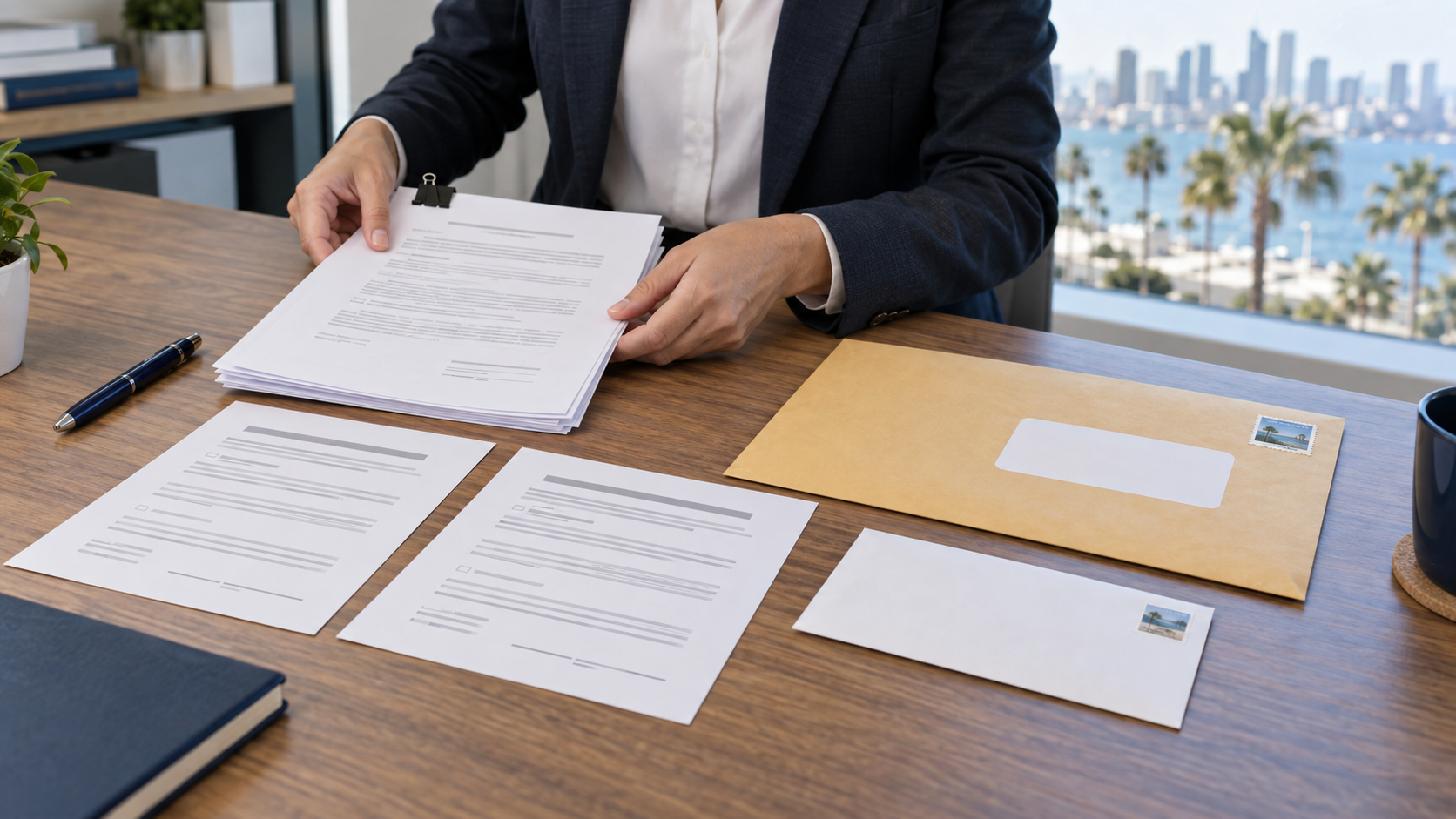
For a California civil summons and complaint served inside the state by mail, Code of Civil Procedure section 415.30 generally requires the sender to include two copies of a Notice and Acknowledgment of Receipt and a prepaid return envelope. Service is not complete when the packet is mailed or delivered. It becomes complete on the date the recipient signs the written acknowledgment, provided the signed acknowledgment is returned to the sender.
Mailing is also part of California substituted service, but it is only one part. After reasonable diligence and delivery to a qualified person at an authorized location, another copy generally must be mailed to the person being served. Mailing the packet without first completing the required in-person delivery is not substituted service.
Different rules apply to later-filed papers, small claims, service outside California, subpoenas, restraining orders, evictions, and court-ordered alternative service. Before relying on mail, identify the document, recipient, applicable statute, service deadline, completion date, and correct Proof of Service.
Legal disclaimer: This article provides general information about California service procedures as of September 2026 and is not legal advice. Service rules vary by document, case type, recipient, location, court order, and current law. An attorney or self-represented party should confirm that mail is authorized before using it and should calculate all response, hearing, and filing deadlines under the rule that governs the specific case.
When Is Service by Mail Allowed in California?
Service by mail is allowed when a statute, court rule, written agreement, or court order authorizes it and every required step is completed. The phrase can refer to several legally different procedures.
For example, these statements may all be true in the right case:
- A summons and complaint may be mailed with a Notice and Acknowledgment of Receipt.
- A second copy must be mailed after qualifying substituted service.
- Later papers may often be served on an appearing party or attorney by first-class mail.
- A California summons may be served on a person outside the state using return-receipt mail under section 415.40.
- A small claims clerk may serve a claim and order using mail that provides a return receipt.
- A judge may order mailing as one part of an alternative-service procedure.
Those methods are not interchangeable. They use different packets, recipients, signatures, completion dates, proofs, and deadlines.
Four Different Types of California Mail Service
| Mail Procedure | Common Use | What Makes It Complete? | Important Limitation |
|---|---|---|---|
| Notice and Acknowledgment under CCP § 415.30 | California civil summons and complaint | The recipient executes and returns the written acknowledgment | Mailing alone is not completed service |
| Mailing after substituted service under CCP § 415.20 | Summons delivered to a qualified person at a residence, business, or other authorized location | After the in-person delivery and required mailing; service is generally complete on the tenth day after mailing | The mailing cannot replace the required delivery step |
| First-class mail under CCP § 1013 | Many papers served after a party has appeared | Generally when deposited in the mail, subject to the applicable rule | Does not authorize mailing every document or every case-starting paper |
| Out-of-state mail under CCP § 415.40 | California summons and complaint served on a person outside California | Statutorily deemed complete on the tenth day after mailing | Requires return-receipt mail and satisfactory evidence of actual delivery for proof |
The first question should therefore be “Which mail procedure applies?” rather than simply “Can these papers be mailed?”
How Does Notice and Acknowledgment of Receipt Work?
California Code of Civil Procedure section 415.30 creates a voluntary mail procedure for serving a civil summons. It can reduce the cost and inconvenience of arranging personal service when the recipient is willing to cooperate.
The sender mails:
- A copy of the summons
- A copy of the complaint
- Two copies of the Notice and Acknowledgment of Receipt
- A prepaid return envelope addressed to the sender
The mailing must use first-class mail or airmail with postage prepaid. Judicial Council form POS-015 is the standard Notice and Acknowledgment of Receipt—Civil used for this procedure.
When Is Service Complete?
Service under section 415.30 is deemed complete on the date the written acknowledgment is executed, if it is later returned to the sender. The date on the postal label is not the service date. The date the envelope reaches the address is not necessarily the service date. The signature on the returned acknowledgment is the essential event.
For example:
- The packet is mailed on September 3.
- The recipient receives it on September 6.
- The recipient signs the acknowledgment on September 8.
- The sender receives the signed form on September 12.
Under section 415.30, the service date is generally September 8, the date the acknowledgment was executed—not September 3, September 6, or September 12.
What If the Recipient Does Not Sign?
If the recipient does not complete and return the acknowledgment, the mail attempt does not become completed section 415.30 service. The requesting party must use another legally permitted method before the service deadline expires.
The statute warns that a recipient who fails to return the acknowledgment within 20 days after mailing may be liable for reasonable expenses later incurred to serve or attempt service through another method, unless good cause is shown. The court decides whether to award those expenses. A process server does not collect them at the door.
This expense provision is not permission to treat silence as acceptance. No signed acknowledgment means the party should not file a proof claiming completed service under section 415.30.
Who Signs for an Individual?
In an ordinary individual service, the named person generally signs the acknowledgment personally, or it may be signed by a person authorized by that individual to acknowledge receipt. A spouse, roommate, parent, coworker, or mailroom employee should not be assumed to possess that authority merely because they received the envelope.
Who Signs for a Corporation or LLC?
When the summons is directed to a corporation, partnership, unincorporated association, or another entity, the acknowledgment must be signed in the entity’s name by a person authorized to receive service for it. The form should identify the signer’s title or capacity.
An employee signing only their personal name without showing authority may create uncertainty about whether the entity was served. Verify the exact legal entity, agent, and signer’s capacity before relying on the returned form.
Is Certified Mail Required for Section 415.30?
No. Section 415.30 describes first-class mail or airmail, postage prepaid, with the notice, two acknowledgment copies, and prepaid return envelope. A sender may use tracking for operational reasons, but a delivery scan or certified-mail receipt does not replace the signed statutory acknowledgment.
This distinction is critical. Certified mail may prove that an envelope reached an address or that someone signed for it. It does not necessarily prove that the correct person executed the Notice and Acknowledgment required to complete this specific service method.
Notice and Acknowledgment Workflow
- Confirm eligibility. Determine that section 415.30 is permitted for the summons, recipient, case, and location.
- Prepare the complete packet. Use the filed complaint and issued summons, not drafts.
- Complete the sender information. Enter the correct court, case number, parties, recipient, sender, and mailing details on POS-015.
- Include two acknowledgment copies. One is not enough under the statutory mailing procedure.
- Add a prepaid return envelope. Address it to the sender responsible for monitoring the response.
- Mail with postage prepaid. Record the date and address used.
- Monitor the 20-day response period. Do not let the underlying service deadline expire while waiting.
- Review the returned signature. Confirm the signer, execution date, and authority when signing for an entity or another person.
- Prepare the proof. Attach or file the acknowledgment as required by the court and correct proof form.
- Calendar from the execution date. Determine the response deadline under the applicable case rule.
When Is Mail a Poor Choice for the Initial Summons?
Notice and Acknowledgment is cooperative. It is often a poor operational choice when the recipient has already avoided communication, the address is uncertain, the deadline is close, the recipient is likely to ignore the form, or the case is contentious.
Consider personal service first when:
- The recipient has refused earlier delivery or mail
- The hearing or service deadline is approaching
- The defendant may move or leave California
- The residence or business address needs verification
- The client needs independent identification of the recipient
- The papers include orders requiring prompt notice
- A reliable Proof of Service is needed without waiting for cooperation
A mail attempt can consume 20 valuable days and still end without service. If time is limited, a process server can begin field attempts while the legal team uses only methods that can coexist under the applicable rules.
Mailing After Substituted Service Is Not Standalone Mail Service
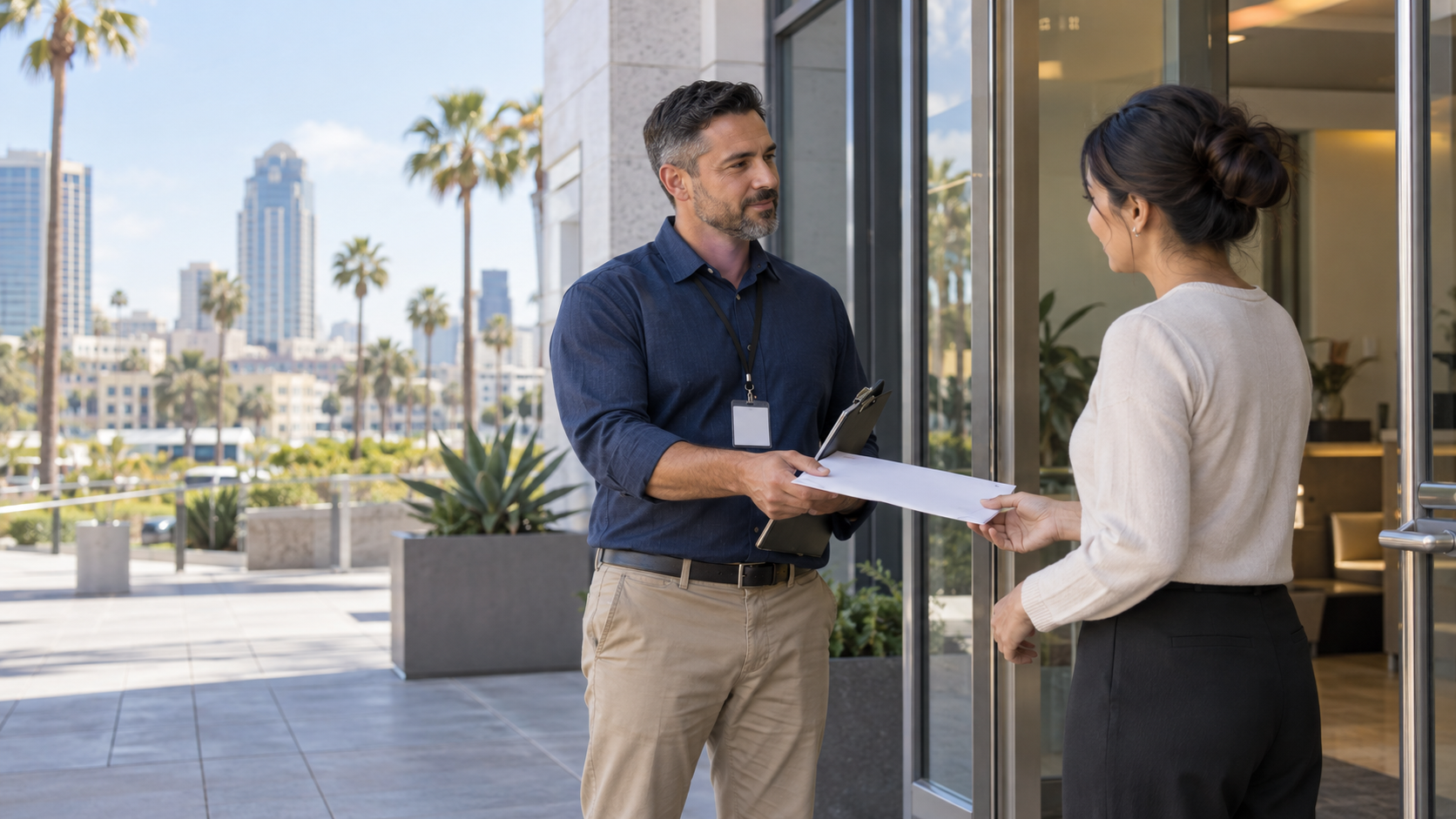
California substituted service of a civil summons generally combines delivery and mailing. The process server first makes the legally required efforts at personal service. If substituted service becomes available, the server leaves the summons and complaint with a qualified person at an authorized location, informs that person of the general nature of the papers, and then mails another copy to the named party at that same location.
For an individual under the version of section 415.20 operative in 2026, residential substituted service commonly involves a competent household member at least 18 years old. At a usual place of business, it commonly involves a person apparently in charge. The facts and recipient category must match the governing subsection.
The Two Required Components
| Component | What Happens | What Must Be Documented |
|---|---|---|
| Delivery | The packet is left in the presence of a legally qualified person at a qualifying address | Date, time, address, recipient’s name or description, age qualification, relationship or role, and notification of the papers’ general nature |
| Mailing | Another copy is sent by first-class mail, postage prepaid, to the person served at the place where the packet was left | Mailing date, mailing address, documents mailed, and person who performed the mailing |
Completing only one component creates a problem. Leaving the documents without the follow-up mailing may leave substituted service incomplete. Mailing documents after an unanswered attempt does not transform that attempt into substituted service.
When Is Substituted Service Complete?
For a summons served under section 415.20, service is generally deemed complete on the tenth day after the required mailing. That date can affect the deadline for the defendant’s response, so the proof must state the mailing date accurately.
Do not confuse three separate dates:
- The date of the last unsuccessful personal-service attempt
- The date the documents were left with the substitute recipient
- The date the follow-up copy was mailed
The client should calculate the next case deadline from the completion rule, not from whichever date first appears in a status update.
Who Performs the Follow-Up Mailing?
The person or process serving company responsible for the substituted service commonly performs and documents the mailing. The task should not be transferred informally to the client without a clear record, because the Proof of Service must accurately identify who completed each step and when.
Before closing a substituted-service assignment, confirm that the mailing actually occurred. “Sub-served” should not be treated as a final status while the statutory mailing remains pending.
For the full procedure, review our guide to service attempts and substituted service in California.
Can Later Court Papers Be Served by Mail?
Often, yes. Once a party has appeared in a California civil case, many notices, motions, discovery papers, and other documents may be served by mail on the party’s attorney of record or on a self-represented party at the address shown in the case. Code of Civil Procedure section 1013 provides a general mail procedure for many notices and other papers.
Under section 1013, mail service is generally complete when the properly addressed, postage-paid envelope is deposited in a facility maintained by the United States Postal Service. This differs from section 415.30, where service depends on a signed acknowledgment.
Who Can Mail the Papers?
The server usually must be at least 18 years old and not a party to the case. The person who deposits the envelope completes and signs the Proof of Service by mail. A party should not sign a proof claiming that another person performed the mailing.
Where Are the Papers Mailed?
Section 1013 generally directs the mailing to the office address most recently given by the person in a document filed in the case and served on the mailing party. If there is no such office address, the statute refers to the person’s residence. Current court records should be checked for a change of address or substitution of counsel.
Does Mail Add Time to the Response Deadline?
Sometimes. Section 1013 generally extends certain periods by five calendar days when the mailing and delivery addresses are both within California, ten calendar days when either is outside California but within the United States, and twenty calendar days when either is outside the United States. Overnight delivery generally adds two court days.
Those extensions contain exceptions and do not apply to every deadline. They do not automatically extend deadlines for a notice of appeal, a new-trial motion, or other procedures excluded by statute or rule. Some deadlines are measured backward from a hearing rather than forward from service. Never add days mechanically without checking the statute governing the particular filing.
Mailing Is Not the Same as Filing
Serving a motion or notice on the opposing party does not file it with the court. Filing and service are separate acts. The legal team must complete both by their respective deadlines and preserve both the court filing confirmation and signed Proof of Service.
Can You Mail Papers Before the Other Party Appears?
Not merely because later papers are usually served by mail. A defendant who has not appeared may still need to receive the summons, complaint, amended pleading, or a document asserting new relief through a method authorized for original process. The rule for ordinary mail service after appearance should not be used as a shortcut for serving a new party.
Before mailing, ask:
- Has this person or entity appeared in the case?
- Is an attorney currently counsel of record?
- Does the document initiate the case or add a new claim?
- Does a statute require personal service?
- Does the judge’s order specify a different method?
- Is electronic service mandatory or agreed for this filer?
Can a California Summons Be Served by Mail Outside California?
Yes. Code of Civil Procedure section 415.40 allows a California summons to be served on a person outside the state by sending the summons and complaint through first-class mail, postage prepaid, requiring a return receipt. The statute states that service through this form of mail is deemed complete on the tenth day after mailing.
Proof requires more than an ordinary mailing certificate. Under section 417.20, proof of section 415.40 mail service must include evidence satisfactory to the court establishing actual delivery to the person being served, such as a signed return receipt or other evidence.
How Is Section 415.40 Different From Section 415.30?
| Question | CCP § 415.30 | CCP § 415.40 |
|---|---|---|
| Where is the recipient? | Commonly used for a person served in California | Person is outside California |
| What signature matters? | Executed Notice and Acknowledgment of Receipt | Return-receipt evidence showing actual delivery |
| When is service complete? | Date the acknowledgment is executed, if returned | Tenth day after mailing under the statute |
| What if no acceptable receipt returns? | The acknowledgment method is not completed | The party may lack satisfactory proof of actual delivery |
Section 413.10 also permits a California summons to be served elsewhere in the United States using a method authorized by California law or the law of the place where service occurs. Personal service by a qualified local server may be more reliable when the deadline is close or receipt-signature issues are likely.
For a complete two-state workflow, read how interstate process service works in California.
Service by Mail in Different California Case Types
California has no single mail rule for every legal document. These examples show why the case type and form instructions must be reviewed before dispatch.
Civil Summons and Complaint
A civil summons and complaint may be mailed using section 415.30 when the complete Notice and Acknowledgment procedure is followed. If the signed acknowledgment does not return, another method is required. Personal service remains the most direct method, while substituted service may become available after the required diligence and includes a separate mailing step.
Divorce and Family Law Papers
A family law summons and petition usually require formal service on the respondent. California family law provides a Notice and Acknowledgment procedure using the appropriate family law form, commonly FL-117, when that method is permitted and the respondent cooperates. A signed acknowledgment is required; simply mailing the divorce packet does not prove service.
Later financial disclosures, requests, responses, and notices can use different service rules and proof forms. Some documents may be served by mail, while documents requesting certain orders may require personal service within a specified period.
Small Claims
Code of Civil Procedure section 116.340 allows the small claims clerk to mail the claim and order to the defendant using a form of mail that provides a return receipt. Under the statute, service through this method is complete on the date the defendant signs the mail return receipt or as established by other competent evidence.
The statute specifically assigns this mailing option to the clerk. A plaintiff should not assume that personally sending certified mail creates the same result. Service generally must be completed at least 15 days before the hearing when the defendant resides in the filing county, or at least 20 days before the hearing when the defendant resides outside that county. Proof generally must be filed at least five days before the hearing.
Certified-mail service can fail when the defendant does not personally sign, the signature is unreadable, the envelope is refused, or delivery is made to an unauthorized person. Personal service may provide more control when the hearing date is approaching.
Restraining Orders
Restraining-order service is highly document-specific. The request, notice of hearing, temporary orders, response forms, and later orders may not all use the same service method. Initial hearing papers often require personal service unless the court authorizes another method or the applicable statute permits it.
Do not place a restraining-order packet in the mail solely because the protected person has a valid address. Review the judge’s service order and the instructions printed on the forms. The order may also set a deadline measured a specific number of days before the hearing.
Subpoenas
A California subpoena generally requires delivery to the named witness under the rules applicable to that subpoena. Mailing a subpoena without personal delivery is not automatically enforceable. Attendance subpoenas may also require tender of witness fees and mileage at the time of service.
Related documents—such as a deposition notice or consumer notice—may follow different service procedures. Do not treat service of related notices as service of the subpoena itself.
Unlawful Detainer and Eviction Papers
Eviction cases move quickly and use specialized procedures. Mailing alone is not the ordinary method for serving an unlawful detainer summons and complaint. Personal service, substituted service with mailing, or court-authorized posting and mailing may be used when the statutory requirements are satisfied.
Posting and mailing is not available merely because nobody answered the door. The landlord generally needs a court order before the summons and complaint may be posted. Under the applicable procedure, mailing is only one component of court-authorized service.
Post-Judgment Papers
Notices, motions, debtor examinations, writ-related documents, levies, and earnings-withholding papers can have very different service requirements. Some may be mailed; others require personal service or delivery to a specific employer, financial institution, levying officer, judgment debtor, or third party.
Never select the method based only on the fact that the case already has a judgment.
Is Email the Same as Service by Mail?
No. Postal mail and electronic service are separate procedures. California electronic service is governed by Code of Civil Procedure section 1010.6, California Rules of Court, party consent or mandatory e-service provisions, and—in some situations—a specific court order.
Forwarding a PDF by email does not automatically serve an initial summons. California law effective in 2026 expanded a court’s ability under section 413.30 to order electronic service in qualifying circumstances after the requesting party satisfies the statutory and due-diligence requirements. That procedure requires court authorization; it is not permission to replace every physical mailing or personal attempt with email or social media.
For ordinary electronic service documentation, see our guide to POS-050 and Proof of Electronic Service in California.
Which Proof of Service Is Used for Mail?
The correct proof depends on the document and method. A proof should describe what actually happened rather than what the party originally intended to do.
| Form or Record | Common Use | Important Detail |
|---|---|---|
| POS-015 | Notice and Acknowledgment of Receipt—Civil | The recipient’s executed acknowledgment establishes the section 415.30 service date when returned |
| POS-010 | Proof of Service of Summons | Must select and complete the method that matches the actual summons service, including attachments when required |
| POS-030 | Proof of Service by First-Class Mail—Civil | Commonly used for qualifying civil papers served by ordinary mail, not as a substitute for a signed summons acknowledgment |
| FL-117 | Notice and Acknowledgment of Receipt in family law | Used when the family law packet and method permit acknowledgment service |
| FL-335 | Proof of Service by Mail in family law | Used for qualifying family law documents that may be served by mail |
| Return receipt | Out-of-state summons mail or clerk mail in small claims | The signature and evidence must satisfy the statute and court |
This table is not exhaustive. Probate, juvenile, administrative, federal, appellate, restraining-order, and local court matters may use different forms.
Who Signs a Proof of Service by Mail?
The adult nonparty who actually placed the papers in the mail signs the Proof of Service. The signer states the mailing date, location, recipient, address, and documents served under penalty of perjury.
If a process server completed substituted service and another employee performed the mailing, the proof must accurately identify those roles. Nobody should sign based solely on office routine without personal knowledge that the described mailing occurred.
What Should Be Checked Before Filing?
- The court name and case number match the filed case.
- The correct parties and recipient are identified.
- Every document mailed is listed accurately.
- The address matches the appropriate court record or service location.
- The mailing date is correct.
- The signer is an eligible adult nonparty.
- The selected service method matches the governing statute.
- The POS-015 acknowledgment or return receipt is attached when required.
- Any substituted-service delivery details are complete.
- The proof is signed and dated.
A signed proof returned by the server is not necessarily filed. The client, attorney, process server, or filing provider must be assigned to submit it and monitor acceptance. Learn more about what happens after service and Proof of Service preparation.
Common Service-by-Mail Mistakes
Assuming Tracking Equals Valid Service
USPS tracking may establish movement and delivery of an envelope. It does not prove that a Notice and Acknowledgment was executed, that the correct person signed a statutory return receipt, or that the document was eligible for mail service.
Using Certified Mail for Every Initial Packet
Certified mail is not a universal California summons method. Section 415.30 requires a signed acknowledgment, small claims clerk service follows section 116.340, and section 415.40 applies to a person outside California. Identify the legal procedure rather than relying on the mailing product’s name.
Waiting Too Long for the Acknowledgment
A recipient may keep or ignore the packet. If the deadline is close, waiting the entire 20-day acknowledgment period may leave too little time for personal attempts, address investigation, substituted service, or a court motion.
Sending Only One POS-015
Section 415.30 requires two copies of the notice and acknowledgment. The packet also needs a prepaid return envelope addressed to the sender.
Using the Wrong Address
Mailing to the complaint’s old address does not establish that the recipient still lives or receives mail there. Check the most recent case filing, registered-agent record, client information, and address verification before sending time-sensitive papers.
Mailing the Papers Personally When the Party Cannot Serve
For many mail-service procedures, the person serving must be an adult who is not a party. A self-represented litigant should select an eligible server and have that person complete the proof.
Forgetting the Substituted-Service Mailing
Leaving papers with an adult household member or office receptionist is not the end of qualifying substituted service. The follow-up mailing and its documentation are essential.
Mailing to the Party Instead of Counsel
After an attorney appears, many papers should be served on counsel at the address of record. Serving only the represented party may not comply with the applicable rule.
Adding Deadline Days Automatically
Section 1013 extensions do not apply to every response or filing. Check the specific statute, whether the period runs forward or backward, the address locations, delivery method, weekends, court holidays, and local rules.
Using POS-030 for a Summons Without an Acknowledgment
POS-030 documents qualifying first-class mail service of civil papers. It does not by itself convert an unsigned section 415.30 summons mailing into completed service.
Practical Service Scenarios
Scenario 1: Cooperative Civil Defendant
A business dispute has just been filed, and the individual defendant has agreed to accept service by mail. An adult nonparty sends the issued summons, filed complaint, two POS-015 copies, and prepaid return envelope. The defendant signs and dates the acknowledgment and returns it. The legal team files the proper proof using the execution date as the service date.
Scenario 2: Defendant Ignores the Mail Packet
The same packet is mailed, but no signed acknowledgment returns. Tracking says “delivered.” That tracking status does not complete section 415.30 service. Before the deadline, the plaintiff sends the documents to a registered process server for personal attempts and may later ask the court for recoverable service expenses when legally appropriate.
Scenario 3: Substituted Service at a Residence
After reasonable personal-service efforts, a server leaves the summons and complaint with a competent adult household member at the defendant’s dwelling and explains the general nature of the papers. The server then mails another copy to the defendant at that address. The proof records the attempts, substitute recipient, delivery, and mailing. Service is generally complete on the tenth day after mailing.
Scenario 4: Motion Served After Appearance
The defendant has appeared through counsel. An adult nonparty mails a motion and supporting papers to the attorney’s address of record and signs POS-030. The filer separately submits the motion to the court and calculates notice using the statute governing the motion together with any applicable mail extension.
Scenario 5: California Summons Sent to Nevada
A California plaintiff uses section 415.40 to mail the summons and complaint to a Nevada defendant through first-class return-receipt mail. The plaintiff preserves the signed receipt and prepares proof satisfying section 417.20. If the receipt does not establish actual delivery to the correct person, counsel considers personal service by a Nevada server.
Scenario 6: Small Claims Plaintiff Sends Certified Mail
A plaintiff independently sends the claim by certified mail and receives a signature. Section 116.340 authorizes the small claims clerk’s return-receipt mail procedure—not a self-created equivalent by the plaintiff. The plaintiff should check the court’s instructions immediately and arrange an authorized method before the hearing deadline.
Mail-Service Readiness Checklist
Before mailing legal papers, confirm:
- The documents are final, filed, and issued when required.
- The exact document type has been identified.
- A statute, rule, agreement, or order permits mail.
- The recipient and service address are current.
- The correct person or attorney must receive the packet.
- An adult nonparty is performing the mailing when required.
- The packet contains every mandatory form and attachment.
- Two acknowledgment copies and a prepaid return envelope are included for section 415.30.
- The substituted-service delivery occurred before the follow-up mailing, when applicable.
- The correct postal method and postage are used.
- The mailing date and location will be documented.
- The correct Proof of Service form is ready.
- The person responsible for monitoring a returned signature is identified.
- A backup service plan exists if cooperation or delivery fails.
- The proof-filing responsibility is assigned.
- The response and hearing deadlines will be calculated from the correct completion rule.
Service by Mail and Process Serving in San Diego
Mail can be efficient for cooperative parties, later civil documents, and assignments outside California. It is less useful when the San Diego recipient’s location is uncertain, a signature is unlikely, the service window is short, or independent identification matters.
San Diego County includes secured downtown residences, gated North County communities, military housing, large business campuses, hospitals, universities, and offices with controlled mailrooms. A postal delivery scan may show that a building received an envelope without establishing that the named person or authorized agent accepted legal service.
A local process server can help when a mail attempt fails by:
- Reviewing the complete packet and written service instructions
- Verifying a residence, workplace, or registered-agent address
- Attempting personal service at strategic times
- Documenting access problems and recipient information
- Completing substituted service when legally authorized
- Performing the required follow-up mailing
- Preparing an accurate Proof of Service
- Providing digital completion or attempt reports
For a close deadline, same-day and rush process service in San Diego can prioritize intake and the first attempt when availability permits. Rush service accelerates the work; it does not guarantee that the recipient will be present or accessible.
If the address appears outdated, use skip tracing and address verification before spending additional time mailing or visiting a location with no reliable connection to the recipient.
Frequently Asked Questions
Can you serve someone by mail in California?
Yes, when the applicable statute or court rule permits it. A civil summons may be mailed with a Notice and Acknowledgment of Receipt, later papers may often be mailed after appearance, and mailing may be part of substituted or court-ordered service. Each procedure has different requirements.
Can I serve a California summons by regular mail?
You may use the section 415.30 Notice and Acknowledgment procedure when it applies, but service is not completed simply by sending regular mail. The packet must contain the required documents, two acknowledgment copies, and prepaid return envelope, and the recipient must execute and return the acknowledgment.
Does certified mail count as legal service in California?
Only when the rule for that document authorizes the applicable mail procedure and its requirements are satisfied. Certified mail is not a universal substitute for personal service or a signed Notice and Acknowledgment.
Is a USPS delivery confirmation enough to prove service?
Not necessarily. Tracking proves a postal event, not automatically the legal identity, authority, signature, or acknowledgment required by the service statute.
When is Notice and Acknowledgment service complete?
Under Code of Civil Procedure section 415.30, it is deemed complete on the date the written acknowledgment is executed, provided the signed acknowledgment is returned to the sender.
What happens if the defendant does not return POS-015?
The acknowledgment method is not completed. The plaintiff must use another authorized method. The defendant may be liable for reasonable later service expenses after failing to return the form within 20 days, subject to the statute and the court’s decision.
Can the plaintiff mail the papers personally?
Generally, the person who serves papers by mail must be at least 18 and not a party to the case. The eligible person who performs the mailing signs the proof.
Can divorce papers be served by mail in California?
A Notice and Acknowledgment procedure may be available if the respondent cooperates and the correct family law forms are used. Mailing the petition and summons without a returned signed acknowledgment ordinarily does not complete that method.
Can a subpoena be served by mail?
Do not assume so. California subpoenas generally require delivery under the rules governing subpoenas, and an attendance subpoena may require witness fees and mileage. Related notices may use a different service method.
Does substituted service require mailing?
For a California civil summons under section 415.20, qualifying substituted service generally requires both delivery to an appropriate person at an authorized location and mailing another copy to the named party at that location.
When is substituted service complete?
It is generally deemed complete on the tenth day after the required mailing. The exact rule should be confirmed for the document and case type.
Can small claims papers be served by certified mail?
Section 116.340 allows the small claims clerk to use mail providing a return receipt. A plaintiff should not assume that independently mailing the claim creates the same authorized service.
Can papers be mailed to another state?
Yes. Section 415.40 provides a return-receipt mail method for serving a California summons outside California. Proof must include satisfactory evidence of actual delivery under section 417.20.
What is POS-030 used for?
POS-030 is California’s Proof of Service by First-Class Mail—Civil. It commonly documents mail service of eligible civil papers. It does not replace the signed acknowledgment required for section 415.30 summons service.
Does mail service add five days to every deadline?
No. Section 1013 extends many—but not all—time periods after mail service. Specific statutes and rules contain exceptions, and some deadlines are not extended. Calculate the deadline from the rule governing the document.
Is emailing court papers the same as mailing them?
No. Electronic service follows separate statutes and court rules. Email does not automatically replace postal mail, personal service, or a judge’s required method.
Should I ignore papers because they arrived by mail?
No. The mailing may be valid, may contain a signed acknowledgment request, may involve an existing case, or may include a deadline. Preserve the packet, check the court and case number, review the docket, and obtain legal advice promptly.
Official California Resources
- Code of Civil Procedure section 415.30 — Notice and Acknowledgment service
- Code of Civil Procedure section 415.20 — substituted service and mailing
- Code of Civil Procedure section 415.40 — service outside California by mail
- Code of Civil Procedure section 417.20 — proof of out-of-state service
- Code of Civil Procedure section 1013 — service of notices and later papers by mail
- Code of Civil Procedure section 116.340 — small claims service
- California Judicial Council form POS-015
- California Judicial Council form POS-030
Need Personal or Substituted Service After Mail Did Not Work?
If the recipient did not return the acknowledgment, the address needs verification, or the deadline is approaching, send us the complete legal documents, recipient’s information, San Diego service address, prior mailing details, and service deadline.
Our team handles personal service, qualifying substituted service and follow-up mailing, registered-agent delivery, difficult-service assignments, skip tracing, and rush attempts throughout San Diego County. After successful service, we prepare an accurate, court-ready Proof of Service based on the method actually completed.